
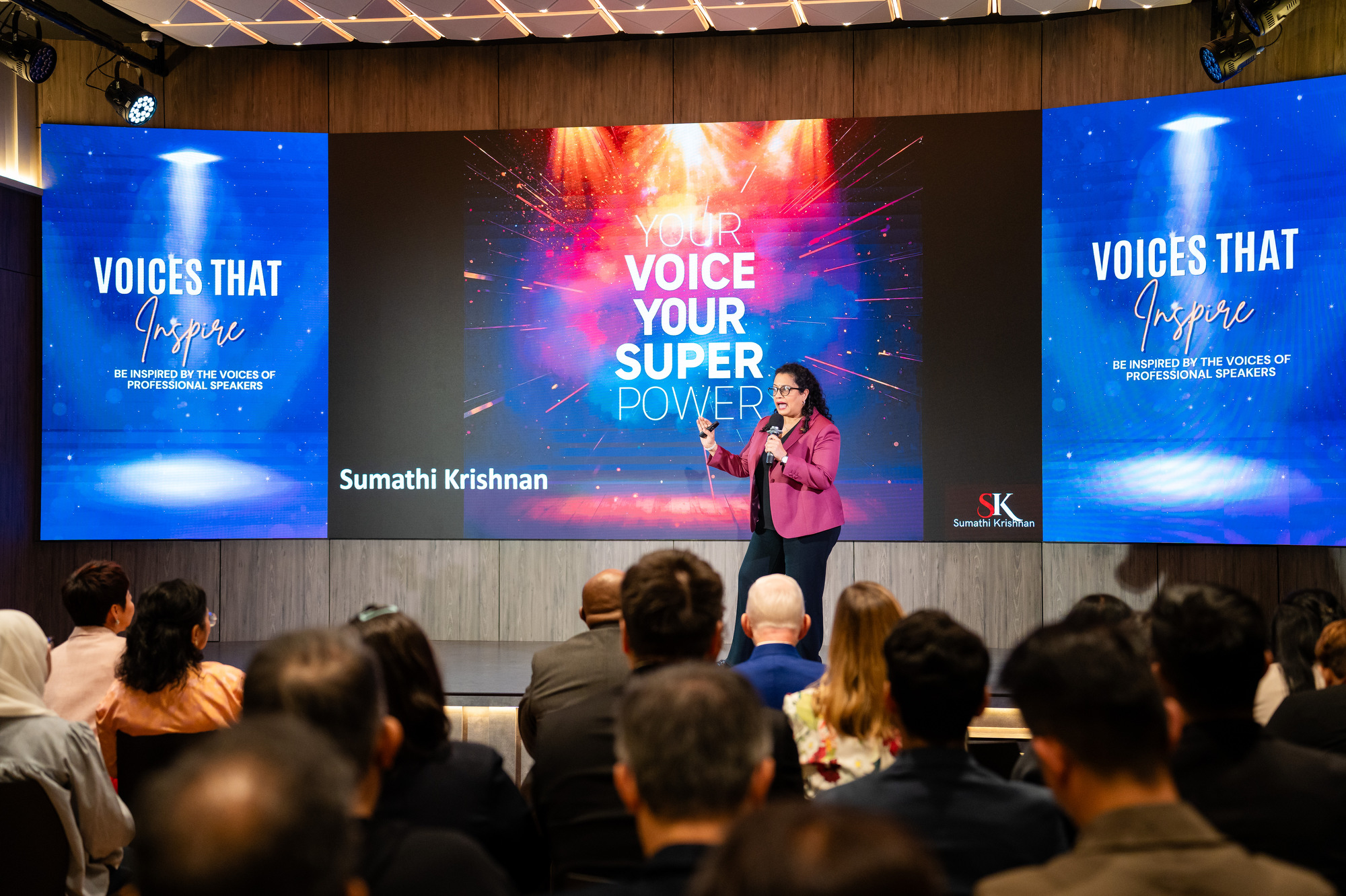

Recently, I had the privilege of speaking to aspiring and professional speakers through an online talk organized by the Malaysian Association of Professional Speakers, of which I am a member of. Most of the speakers I met are also HRDC trainers, and most of them have many hours of experience being on stage. My goal was to help these individuals elevate their personal brand through visuals. One message that has been replaying in my mind – Presence is decided before you speak.
Let’s do an experiment. If you were choosing a speaker for your company and came across several of these LinkedIn profiles, who would you instinctively shortlist? Let’s assume all of them are equally experienced, speak on similar topics, and have strong credentials.
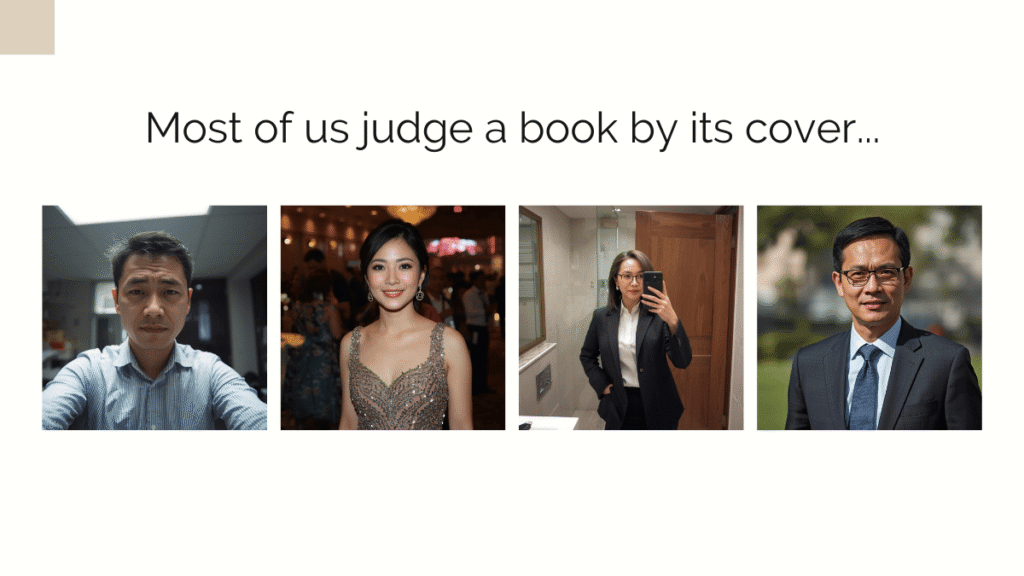
The reality, uncomfortable as it may be, is that most of us still judge a book by its cover. Not because we’re shallow, but because visuals are often the first signal of trust. These headshots are not great examples, because they have
- Poor lighting
- Distracting backgrounds with inappropriate attire
- Selfies that look unprofessional even though you might dress the part
- Expressions that do not look warm (squinting at the sun)
Thankfully, I didn’t have to shame anyone because these are all AI generated examples.
The truth is, before a speaker is booked, introduced, or heard on stage, they are usually seen online. And the simplest way to connect is to search for their profile on LinkedIn.
So what does visual presence mean?
Visuals are not about merely looking good on a poster. They are about alignment and building intentional presence. It answers these 3 questions:
- Credibility: Do I look professional and trustworthy?
- Clarity: Can people quickly tell what I speak about?
- Energy: Does my visual match how I show up on stage?
Ultimately, it differentiates you, because many speakers have similar topics but few are intentional about how they show up visually.
The First and Most Important Step: A Professional Headshot
A professional profile photo is the most basic, non-negotiable visual asset for any speaker.
It appears on LinkedIn, speaker profiles, conference brochures, and websites. It often becomes the first impression people have of you.
Yet this is also the step many people delay the longest.
“I’ll do it when I look fitter or slimmer.”
“I don’t have time right now.”
“I’ll do it when I’m more established.”
I hear these reasons often, and they are deeply human. Being seen can feel vulnerable. Many people are uncomfortable looking at themselves in photos, let alone choosing one to represent them professionally.
But a weak or unclear headshot doesn’t reflect who you truly are. It simply creates hesitation.
A good headshot doesn’t need to be dramatic or perfect. It needs to be clean, well-lit, appropriate to your speaking market, and reflective of your energy. You should look like someone people would feel comfortable listening to.
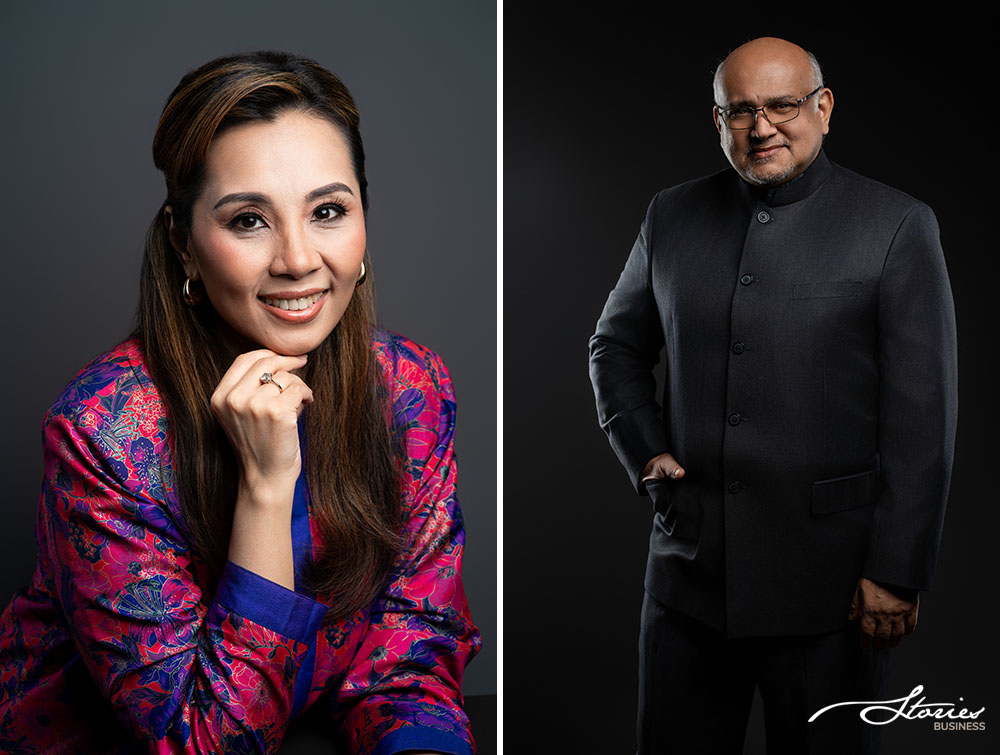
If there is only one visual asset you choose to improve, start here.
The Next Layer: Personal Brand Video
Once people recognise you visually, the next question they often ask is: “Who is this person, really?”
This is where a personal brand video comes in.
A personal brand video is not about being polished, loud, or impressive on camera. It is not about selling yourself. At its core, it is simply a way for people to hear your voice, sense your personality, and understand why you do what you do.
The most effective personal brand videos are not the most elaborate ones. They are the clearest.
A good personal brand video usually answers a few simple questions:
– Why do you speak about this topic?
– Who are you hoping to help?
– What do you genuinely care about?
– What makes your perspective different?
It doesn’t need to tell your full life story or list every achievement. It only needs to help someone feel, “I get this person.”
For speakers, this kind of familiarity builds trust quietly, long before a conversation ever happens.
Interestingly, one of the TTT trainers that we created a personal brand video for, Jeya Seenivasagam, shared this story with me recently. He said that one of his participants flew over from Kuching to Johor to attend his HRDC TTT training there. He was puzzled as to why she would do that as there are many qualified trainers in Kuching. She said that she felt connected to what he shared and trusted him immediately after she watched his personal brand video. So she made the decision to choose him as her trainer. What an amazing story! If you’re curious, you can watch his video below:
The Speaker Showreel: Trust on Stage
A speaker showreel is often the most intimidating visual asset and also the most misunderstood.
Many people assume they need to be very established, speak on big stages, or have perfect footage before they can even consider creating one. But a showreel isn’t about how famous you are. It’s about how you show up.
For organisers and bookers, a showreel answers one essential question: “Do I trust this person on my stage?”
It’s less about backstory and more about proof. Your energy, body language, clarity, and connection with an audience matter more than production perfection. A good showreel allows people to see and feel your presence in action.
Start Small, Start Now
Building presence through visuals is not about doing everything at once. It’s about taking intentional, manageable steps. Most people delay this process because they are hoping to lose weight first, waiting to feel more ready or credible, or they just feel that they do not have the time to invest in visuals. The important thing to remember:
Photos help people recognise you.
Videos help people feel you.
A showreel helps people trust you.
You don’t need to look like a celebrity speaker. You just need to be a little more visible than you were yesterday. Presence is not built through perfection but through clarity, intention, and the courage to begin. How would a small step look like to you? Here are some suggestions for you:
- Audit your photos and videos online – when was the last time you updated these? Do they still represent who you are?
- Start recording all your speaking engagements, even if it is through your phone.
- Invest in a good wireless mic that connects to your phone so that you can get great quality audio.
- What are 3 punchy phrases that you would like to be remembered for? Reflect and write them down.
- Message your previous clients to ask for testimonials so that you have a good depository when you need to flash these out in any video.
- Book a 30-minute professional headshot session at the Stories studio!
And when you do, it’s time to celebrate all your small wins!